-
9 Vintage Photographs of Everyday People
The best thing about old photographs is that they show us what life was like in the not-too-distant past.

We see the goodbyes, the hellos, the see-you-soons. These old photos represent the memories of people that can’t speak to us anymore, and who couldn’t leave behind videos the way we can now. Can you imagine how easy it will be for our descendants to understand—or at least know—our time period? Between the video cameras of the mid-20th-century and the cell phone footage of today, they’re set. They’re going to know everything we were up to—if anything is preserved, at any rate.

A simple farmhouse, a portrait of a family at rest.

This is likely out by one of the outbuildings, or a barn, it’s hard to say. Note the windows lack glass. I have no doubts that building is still standing today, if it wasn’t knocked down by other people.

A (presumably) happy time. I particularly like the the wear and fading on the edges of this photograph because it lends some extra character to a picture that already has a fair bit going on.

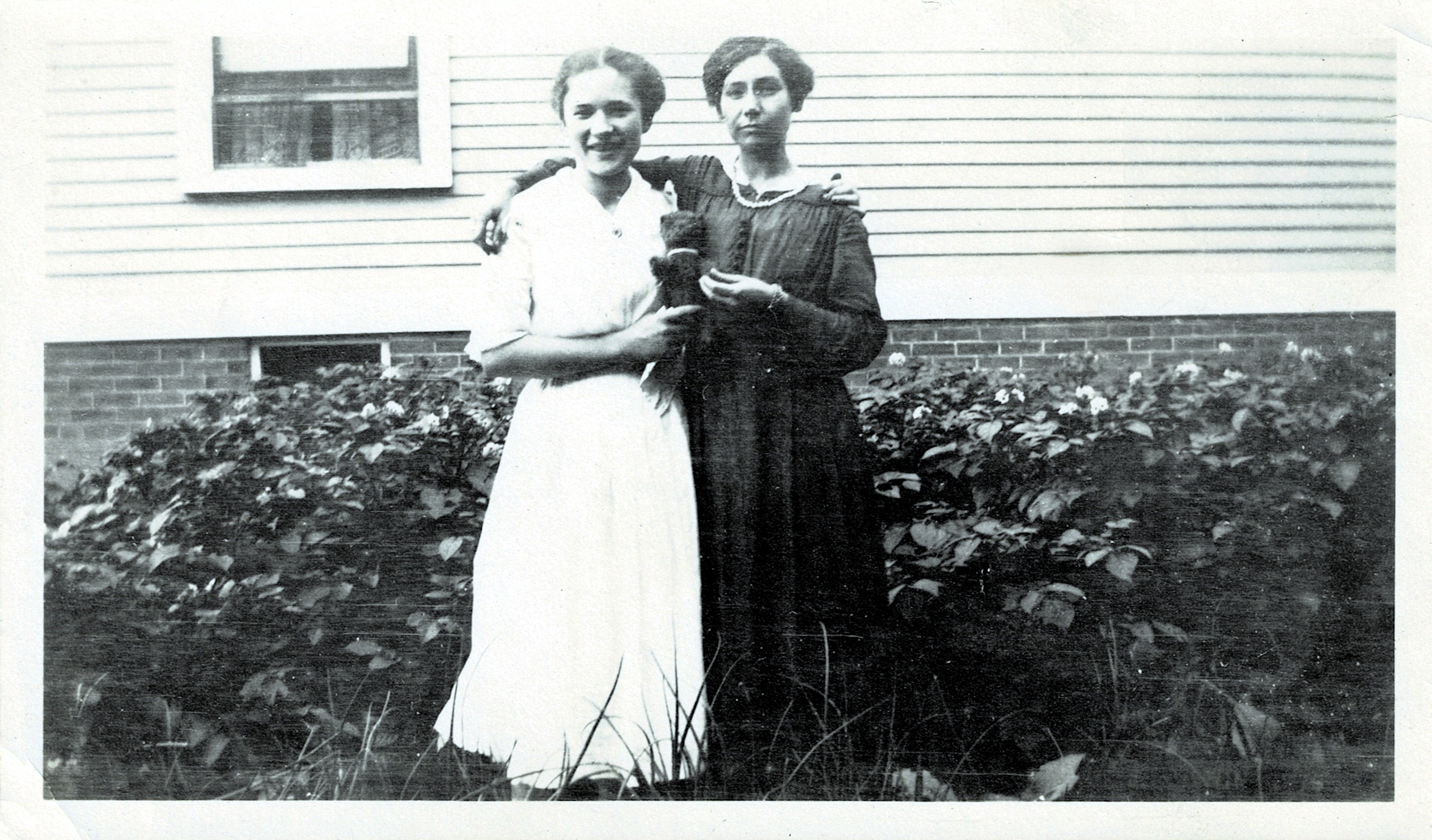
In my attempts to figure out what “Angels Black As Night” even means I have only found references to the Night Witches of WWII. I don’t imagine these two have anything to do with them, as I don’t think these pictures are from Russia, but I really have no way of knowing. All I can see is two people standing together in front of a hedge or tree. Maybe there are other things I’m missing!

Photographed on horseback in a surprise “hey, say cheese!” sort of pose. Or maybe it’s a “stop screwing around and get back to work” pose. We almost have an excellent silhouette here if you ignore that the front hooves are cut out of the frame!

An attempt was made to get a nice photo of the kids, and it went mostly alright. The little fella is not pleased to be standing getting his picture taken, and the little girl doesn’t seem overly enthused, either. That’s a “I don’t want to smile so I’m gonna pretend” smile if I’ve ever seen one!

A very nice photograph of a young girl with a… fish bowl? It’s hard to tell if there’s anything in there, even with zooming right in close, so I’m not sure if that’s just a house decoration or if there may be a pet in it. Folks certainly didn’t know any better then, and they’re too stubborn to house the poor things properly nowadays (yes, goldfish need filtration and a lot of space). A special occasion, maybe?

This young fellow is looking dapper all dressed up, and the wear from storage adds a slight creepy factor to the photographer’s shadow. This would be a great photo to play with for a horror-adjacent project. Turn the boy into a critter, add some stuff into the background—the possibilities are endless!
That’s all for this week. Stay tuned for more free vintage images, including some colouring pages from an old Saalfield activity book!
***
I am slowly working on fleshing out and expanding some of my older entries so that they’re more interesting, and more worthwhile to browse. If you go back into the depths of the blog you may notice the changes that have been made!
Like separating gallery blocks into single images.
I am hoping that this helps with visibility, and it will cut down on the number of posts that just have one or two images. I want to make your visits worthwhile, after all!
-
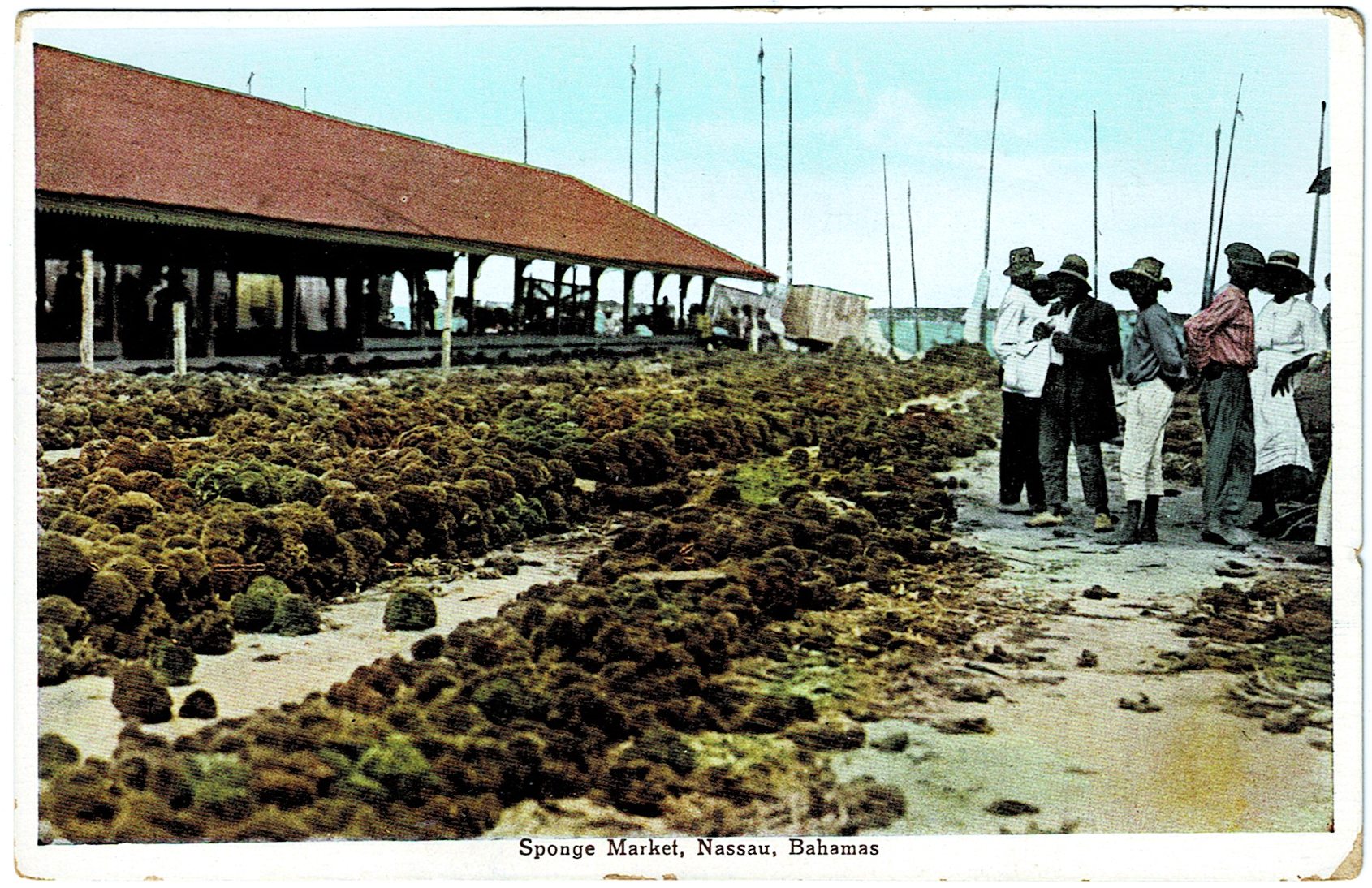
Sponge Market, Nassau, Bahamas Postcard
There was a time when the Bahamas were a hotbed of sponging activity.
Hundreds of ships harvested sponges from the islands’ crystal-clear waters, resulting in an export of over a million pounds in 1917 alone for use in homes around the world. Sponging brought good money to families that took part, and spongers could make a decent living diving for the aquatic invertebrates.
The sponging industry in the Bahamas briefly died in the late 1930s after a fungus wiped out the sponge beds, then saw a revival in the 1950s. There has been a push to renew and modernize the sponging industry over the last decade or so.
The real photo postcard below shows a sponge market in Nassau, Bahamas. Divers or spongers on a ship would harvest the sponges from the sea floor with a special tool: a long pole tipped with a cutting hook. The sponge would be cut above the base, leaving some of the creature behind, and the sponges would grow back within a few years.
Upon returning to port, the harvest would be unloaded, cleaned, sorted, and dried. Sponges could be sold once they were dry. Not much has really changed since then—the harvesting method is still about the same, though most often sponges are cut by someone on a ship and not by a diver.

As much as things have changed, one thing remains the same: the demand for Bahamas sponges is still high. They are a renewable resource that does extremely well in the waters off the islands, and, unlike synthetic sponges, they are biodegradable. They’re probably not quite as disgusting as the synthetic ones, too. Those suckers smell weird after the first use.
… I think I might need to go shopping.
Anyway, if you haven’t subscribed to my mailing list while you’ve been browsing the site, I’d love it if you’d join me. You’ll be notified when new posts go up, and you’ll be the first to know of any fun features I add to the site—plus, I won’t spam the heck out of you. I’m not a barbarian, after all.
Thanks for reading, see you again soon for some more vintage images.
P.S. Have you visited the shop lately? You should.
-
A Hard-Working Postcard
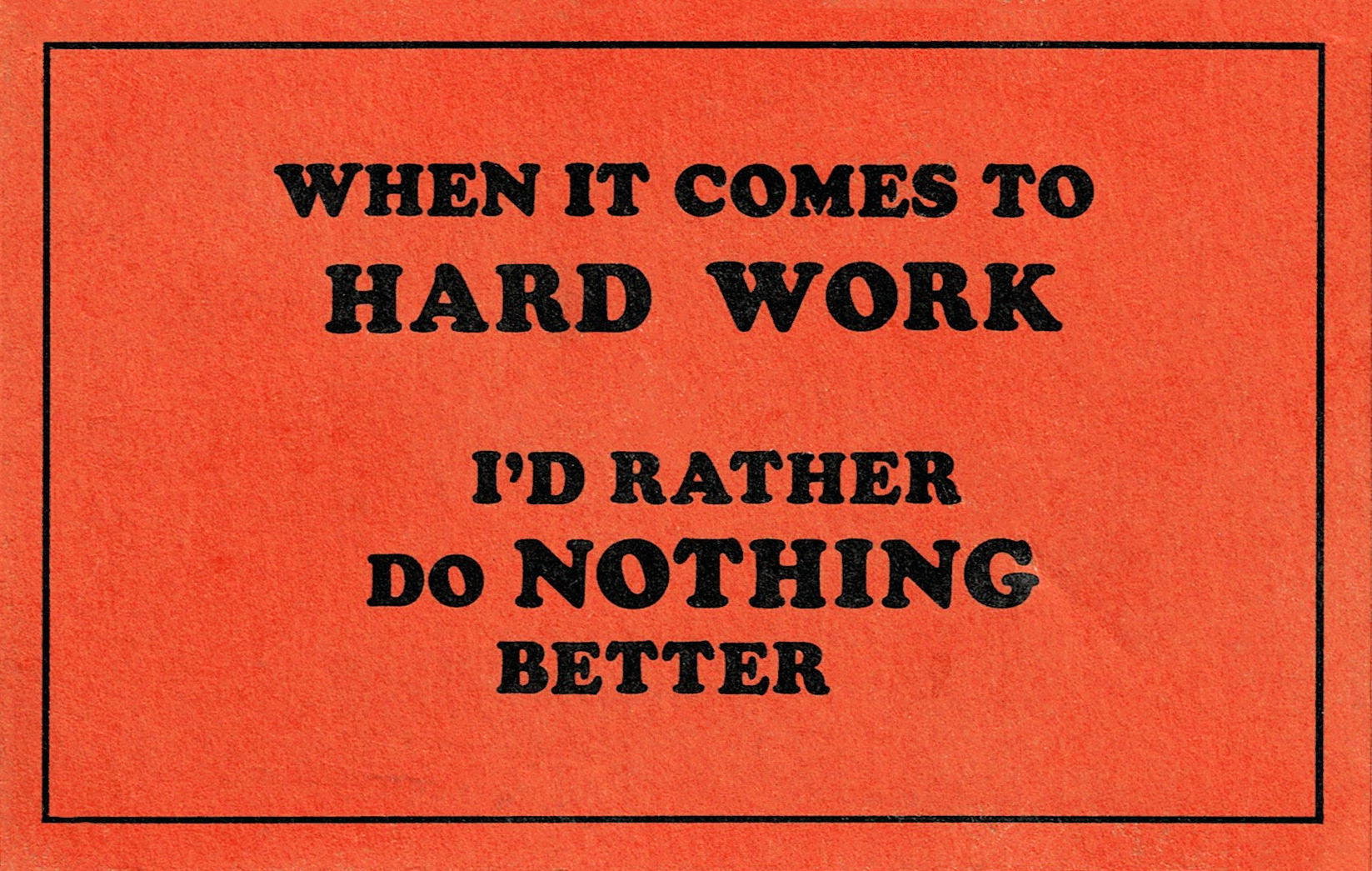
Working hard? Hardly working? I think this vintage postcard does a good job of stating the obvious:

When it comes to hard work I’d rather do nothing better. Same here. Same here.
Unfortunately for me, I’m not programmed to just ‘do nothing’, and my idea of working hard looks like ‘doing nothing’ to the people around me! Those of you that do similar work to mine know that feeling all too well, eh?
“What are you doing?”
“I’m working.”
“You’re just on the computer!”
Well, yes. That’s where my work is! Of course I’m on the computer. Look, see? I’m even writing a blog post! You’ll be able to read it in 10 minutes!
Ahem, anyway.
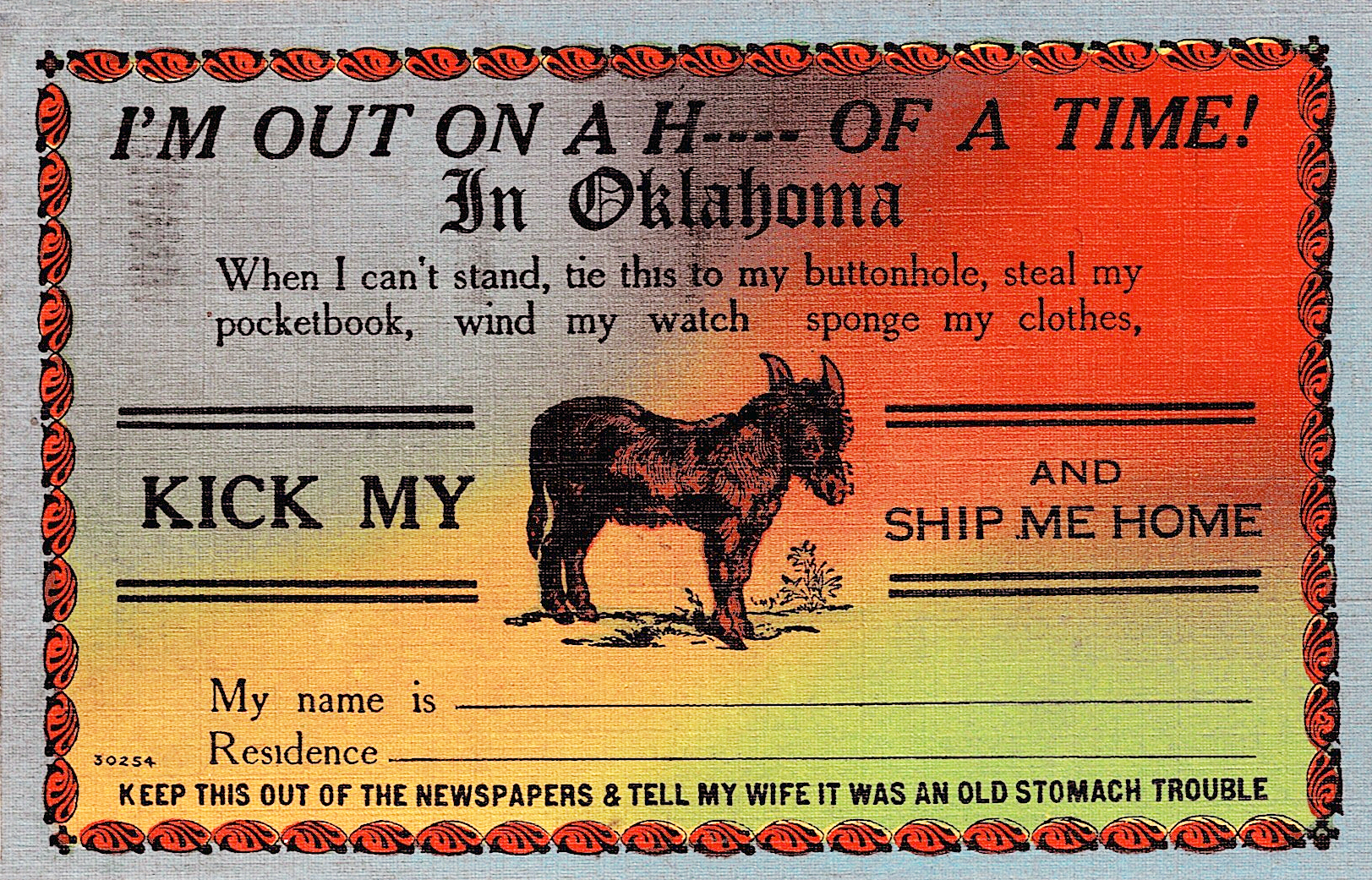
The above postcard came with the same batch that included the ol’ Oklahoma jackass, so there are a handful of other gems waiting in the wings to be revealed. It’s so simple! Sometimes simple is the best thing ever and gets our messages across without wasting too much time. Bold text on a bright colour is eye-catching enough without needing anything else to make somebody look.
In the past weeks I’ve been working on preparing a bunch more vintage graphics for the site, brainstorming what else to offer, and tweaking what my internet presence looks like. I’m spread so thin between Ko-fi, Etsy, here, and social media expectations that I’m starting to lose my mind! I’m also seriously considering going back to school for a proper career change. I just don’t know what. As tempting as getting a full Graphic Design education is, I just… don’t want to do that at a corporate level. Know what I mean? Doing creative stuff for other people full-time, stuff I don’t have much control over, is a great way to completely burn myself out.
I’m leaning toward accounting. I’m not terrible with numbers, I enjoy playing with them, and it’s different enough from the things I like to do for fun that I won’t burn out on it so quickly.
That doesn’t mean I’ll be giving this up any time soon! It might actually give me more time to work on it, if it gives me the means to start my life over again!
Anyway, what about you? What have you been working on?
-
Have a Hell of a Good Time in… Oklahoma!?

Oklahoma.
Out of all the possible places to find yourself black-out drunk, Oklahoma in the early 20th century is not the first on my list, nor does it make it into the top ten. Not even the top twenty.
Oil was discovered in Oklahoma at the tail end of the 19th century. That brought all sorts of riff-raff out into the wilds of the state to start drilling for black gold, and every time pay dirt was struck out in the middle of nowhere, a boomtown would crop up. These boomtowns lacked the municipal government, infrastructure, and law enforcement of established towns, and some of them never had the opportunity to develop that far. Those that did lasted well beyond the initial oil boom. Those that didn’t disappeared as quickly as they’d been built up.
There’s at least one boomtown that was gone within two years, for example.
And Oklahoma wasn’t exactly an alcohol-friendly state. Before statehood, Oklahoma was two different territories: one was dry, one was not. The Anti-Saloon League and Woman’s Christian Temperance Union were not happy with the sale of liquor at all and engaged in fierce fighting to outlaw it.
They got their way when Oklahoma became a state in 1907. That didn’t stop all the wild nonsense that tended to happen within the boomtowns, though: by their very nature the boomtowns were lawless places, mostly fly-by-night, and full of businesses meant to drain oil workers’ wallets.
And if those workers wanted to drink, by God, they’d get their drink.
So, yes, you really could, against all odds, have a hell of a good time in Oklahoma—depending upon your idea of a good time.
-
Wartime Latrine Humour with Exhibit Supply Company
Arcade machines were all the rage in the early 20th century. One company maintained its spot at the head of the pack for nearly one-hundred years by producing machines and their prizes, and that company was ESCO: Exhibit Supply Company.
Established in 1901 in Chicago, ESCO jumped feet-first into the very niche arcade merchandising industry and hit the ground running.
Penny arcades were still relatively new at the time, and allowed people to play carnival-style games without the need for a human to actually run the thing. J. Frank Meyer founded ESCO with the idea that there was a need for prizes for specific classes of these machines—namely, picture card vending machines. The user would insert a penny and get a picture in exchange.
Pictures came in various styles, with different series available (numbered, even) and subject matter ranging from raunchy comics to pretty ladies. These picture cards were collectible then and now, and they were only available from ESCO and their machines.
ESCO’s cards were printed on heavy stock in duotone, at a quality comparable to a photograph, almost guaranteeing that many would outlast the machines themselves (and sometimes the people that purchased them). Postcards and picture cards from ESCO are still available online, with some being sold in lots or as singles on eBay and from other private sellers.
During WWII, ESCO’s arcade machine production was put on hold, but they were still allowed to produce wartime card sets for their existing vending machine stock. The paper shortage didn’t hit them nearly as hard as it could have! From fake love letters to funny cards about life on the front lines, the factory printed all sorts of new material to help keep everyone’s spirits up. This is one such card:

This arcade card was produced as part of a set in 1943 that was full of risqué little comics, especially involving women, especially involving wartime activities.
After over 70 years in business, with only a fraction of its previous roster of employees, ESCO was sold to a sports card dealer in 1979. He sold off most of the machines and parts, but he kept the massive archive of photos that was used to produce the company’s arcade cards; he continued to produce sets from these archives until dissolving the company in 1985. The story of Exhibit Supply Co. had come to an end.
Examples of their arcade machines and cards can be found in museums and archives, especially the Made in Chicago Museum, which is where I learned all about ESCO—and you can continue the educational journey!
I wonder where the over 7,000-piece photo archive from the company’s heyday has gone, and if the last owner still has it in storage? A box of original ESCO photographs would be the find of the century! Especially if it was a complete series.
***
Sign up to my mailing list and get 15% off your first purchase in The Paper Girl shop. You will receive a digest that gives you a neat and tidy round-up of everything posted that week. It’s an easy and pain-free way to keep up with the blog without having to remind yourself to visit.
-
Daydreaming About Love in This Real Photo Postcard
RPPCs were a playground for the photographers and are little works of art themselves, using a multitude of techniques to help them stand out from the crowd.
I’m not being cutesy here: between commercially-offered real photo postcards and those made by private citizens for personal use, there are likely hundreds of thousands, if not more, different images floating around in the world today. To stand out, you needed to do things that caught the eye: like hand-colouring your postcards before colour photography became common, or making whimsical additions to your work.
And that’s where this postcard by Myosotis comes in.

In this image, the girl’s clothing, flowers, and other elements are hand-coloured and we get the equivalent of a ‘thought bubble’ in the upper corner that shows our subject with her beau. How sweet!
The unfortunate part about this real photo postcard is that I cannot, for the life of me, find any information on the company—Myosotis, if I’m reading the name correctly at all, is the genus for a little flower called the Forget-me-not. You know. Those flowers we talked about a little while back with their pretty blue (or white or pink) blooms.
That’s fitting, really, for a postcard company or any artistic endeavour: every artist wants to be remembered, why not the photographers, too?
***
You may have noticed of late that things have been a little slow—I’m picking at making some changes as I go along here, and I’m dealing with some stuff in real life that has made it difficult to do any writing. That said, I’m still editing images to post here. I haven’t forgotten. I’m consolidating my online stores so that I just have this one, I’m taking things like Ko-fi and rolling the functionality into this site, and I’m trying to make things easier for my ADHD-addled brain to handle.
And, yes, I’m getting assessed for ADHD and the mood disorders I’ve been dealing with for a decade, which may be part and parcel and all the same thing.
I know the general wisdom is don’t put your eggs all in one basket, but I only have so many hands and can only wrangle so many baskets at once. It’s an ongoing process.
On top of all that, I may or may not wind up losing my office space after December 2023, so I’m trying to get as much material scanned (and the physical copies sold off) before that happens. It’s really difficult when I don’t get much time to actually… work on this stuff, and my brain isn’t cooperative, but I am doing my best.
***
Do you like to make things with vintage images? Show me what you’ve done and I may showcase it on my blog! I love to see what people make and do, and it would be fantastic to be able to show off my readers’ creativity! What’s something you’ve made recently that you’re proud of?
For creator showcases I need links to your work, such as your blog or an image gallery, and a little blurb about you. It would be cool to make a regular feature of such a thing!
-
What are Postcards Used For?
If you’re not familiar with postcards—and that’s not as ridiculous a thought as it may sound!—then it’s likely you’ve wondered about their purpose.
The very idea of the postcard has been in existence since the birth of the postal service. They’ve been created and recreated every time a country has decided it needed a way to get correspondence to citizens within and outside its borders. Affordability of mail has also always been a concern.
And that’s exactly where postcards come into play.
A Brief History of the Postcard

In the United States, the earliest example of a postcard was a piece of advertising that was sent in 1848. In the United Kingdom, it was writer Theodore Hook that sent himself a caricature of postal workers in 1840.
Austria-Hungary issued its first postcards in 1869, based on an idea proposed by a Dr. Emanuel Herrmann. They caught on very quickly. Britain followed with its own official postcards in 1870 that they based on Hungary’s model. The main benefit in every case was the cost: sending a postcard was inevitably cheaper than a regular letter—sometimes half the price!
That’s why they caught on so quickly. In the early days, postcards didn’t have pictures on them—there were lines or a blank space for the address, and then sometimes someplace to write a note. They didn’t start having pictures on them until the 1890s, and that’s about when collectability (and popularity) soared.
Postcards Are Small Pieces of History
Vintage postcards represent a wealth of information about the past.
We can learn about fashions and events, locations and people. There are postcards for just about everything: cat breeds, political comics, current (for the period) events, even towns and their attractions.
Anyone that isn’t familiar with Ontario Place, for example, could learn a bit about what it looked like and why it existed from souvenir postcards. Metro Toronto Zoo also had postcards showing the monorail, which was shut down in 1994. If you didn’t grow up with it, you didn’t know it existed beyond overgrown tracks and ruins. Collecting these postcards helps preserve that history for future generations, when it could otherwise be lost.
There was even a time when postcards represented a cheap way of advertising your business or product to the masses, and I have found examples from the early 20th century showing off things as simple as laundry soap. During the 1990s it was so common to get advertising postcards that much of that mail went in the trash!
For many of us, postcards represent a way to reach out and touch the past, and to remember what came before us.
How Are Postcards Used in 2024?

Once again, postcards are becoming a viable way of advertising as mass printing costs go down and people look for new ways to tell people about their products. It’s easy to be overlooked on social media and the internet, plus, online advertising can be expensive.
Sometimes prohibitively so.
Canada Post makes deals with businesses all the time to get their advertising materials out in the mail (a business account for Canada Post is free and grants several useful discounts). We don’t get quite as much junk mail as we used to, after all.
People still collect postcards, they can still be purchased to mail out or just hold on to. Some people use vintage postcards in their crafts—hello, friends!—and several local museums keep them on hand as part of their collection. A postcard of a long-gone historic site is still an important record that the place existed.
Why Do People Collect Postcards?
One of the best things about collecting postcards is that it isn’t an expensive hobby to get into. Once you figure out what sorts of pieces you’re after—maybe they tie into your interest in local history, maybe you like postcards of cats!—all you have to do is look for them. They can be found at fleamarkets, antique stores, online stores, eBay, even auctions. I have been buying postcards online for years, for example, and I’ve paid as little as $2.00 for 15 pieces.
My last batch of 100-year-old ephemera and greeting cards was purchased as part of a lot where the main attraction was an antique lockbox, for example. You just never know.

The prices go up as you seek out more specific cards, rarer pieces, older ones—but it’s up to you how deep you go and how much you want to spend.
Some collect them because it’s an easy way to get our hands on unique pieces of art without breaking the bank, some do it just because they like them. There are as many reasons to collect as there are subjects, and if you aren’t into the old stock, many modern artists put their work on postcards, too.
I hope I’ve helped clear up any confusion about what postcards are used for, and if you have any other questions about postcards, why not contact me? I’m always happy to help.
-
5 Vintage US Postcards
It’s time for a trip with some vintage US postcards. As a Canadian, I tend to be focused on Canadian sights, but it never hurts to branch out. 😉
Bethel, Vermont Train Station Vintage US Postcard

A Bethel, Vermont, train station. This Bethel train station now known as Babes Bar and retains its 1850s charm with its original architectural details. A progressive entertainment space with its own library and kids’ zones, Babes looks and sounds like a cool place to visit.
If you do go, tell them you found them on The Paper Girl. 😉
There are records for the Bethel, VT train station that go back to 1875; it was part of the Central Vermont Railroad Company and operated as a train station until the 1940s.
Vintage US Postcard of Everglades National Park

A palm-lined drive in Everglades National Park, Florida, number 291 in a series. This linen-textured postcard features someone taking a drive through the scenic Everglades. It looks like a pretty place to be—when the temperature isn’t skyrocketing!
The car looks like a Buick Century or a Chevrolet Special Deluxe, but it’s difficult for me to make out. The grille doesn’t seem right.
Everglades National Park was established in 1947 with over 1.5 million acres of land—making it the largest subtropical wilderness in the USA. Invasive pythons thrive there. So, you know, just stay inside the vehicle. It’s safer that way!
Speaking of Florida, you might wanna skip this postcard if you don’t like snakes. It’s a bit of a slithery fella.

This is a postcard of a double-headed rattler (and a single-headed cousin). Animals with two heads are bicephalic. This genetic anomaly happens in the womb and is the result of an embryo attempting to split into twins but not quite getting there.
Bicephalic snakes are one of the most common types of two-headed animal. Unfortunately, they don’t survive for very long in the wild, but have proven to live full lives in captivity—one such snake lived for over 20 years.
Hair Pin Turn, Mohawk Trail, Massachusetts Postcard

Hair Pin Turn, Mohawk Trail, Mass., is another linen-textured postcard. This location is accessible today, though the scenery has changed somewhat—the Golden Eagle Restaurant in the background is now located behind a nearby rock cut.
Why, you ask?
After 44 years without trouble, two major big rig accidents took place that destroyed the restaurant and forced a rebuild. The first accident took place in 1958, the second one just 4 months later.
Although you’re less likely now to get taken out by a truck while eating, it’s still a kinda dangerous roadway—especially when the fog rolls in.
Three Ways to Detroit

For 61 years the ferries plying the waters between Windsor and Detroit were the only way to get to the Motor City from Essex County. From 1877 to 1938, The Detroit and Windsor Ferry Company’s steamers carried people and cargo across the waves and contributed to the local economy.
When the Ambassador Bridge opened in 1929 it heralded the beginning of the end for Windsor’s ferries, and the death knell came with the Detroit-Windsor tunnel in 1930. Unable to compete, the ferries were shut down in 1938.
This is another of those vintage US postcards with that weird linen texture, which is why it looks the way it does up there.
That’s all for this week. See you again soon!
P.S. Consider buying me a coffee or subscribing to my newsletter to help support the site. This is a passion project, and earnings from products, affiliates, etc. help me spend more time writing and editing.
-
5 Vintage Wedding Cards
Since we’re in the marriage season (because people, for some reason, don’t like to get hitched in the snow?) I figured it was a good time to post another batch of wedding-related cards. We have brides! Gold foil! Candles! All the cards here are from companies that no longer exist.

For your wedding… FIRE! Please enjoy.
This was for a wedding gift, and those little white dots are supposed to be part of the flower arrangement. Baby’s breath, maybe? I’m not sure a lone rose needs that, but, whatever, just run with it. Candles on cards in this era tend to have magical floating flames that are a bit confusing. My eyes are also terrible.

For your wedding, a bride and groom that look like they stared into the abyss and it stared back. I’m sure the artist meant for them to be staring lovingly at each other, but it just doesn’t really… work. The cake is pretty, though! This is a great shade of blue.

Okay, this is a wedding anniversary card. Same difference. Loving the lace-looking edge. The bell lock is an interesting touch. This card is kind of a gift because there are so many pieces that can be picked apart to use as their own elements—the flowers! The key! The frame and lace edge! So many options.

A stylish dress, flowers everywhere, questionable anatomy—this card has it all. I am actually a fan of the calla lily bouquet, though not so sure I’m gonna like whatever evil thing these two are planning. Very suspicious couple, do not recommend.

I like this wedding card because it’s a photograph of a framed picture. There is so much gold, gold everywhere, all the gold. I hope you like gold. It’s just an interesting arrangement that does not scream “congrats on the wedding!” to me. I could see this image being a great sympathy card—not so blatant in the “I AM SO SORRY FOR YOUR LOSS OH MY GOD they rest with the angels now” imagery as most in that category.
Thanks for browsing! Have you received any interesting wedding-related cards, or run across them in your adventures? Share them in the comments!
Do you like what I do here? Consider supporting me on Ko-fi.
-
5 Vintage Wedding Bell Images
I know a while back I mentioned that I have a lot of mid-century greeting cards (of which only a handful are really usable, alas), and I also know that I may have mentioned that there was a lot of bridal shower-related content in that batch.
With bridal showers comes weddings and wedding bells, and I figured you’d appreciate some wedding bell content, for some reason. On with the show!

I like the simple colour scheme in this card, though I didn’t appreciate the texture when I was cleaning it up. Huff, pout, etc. The little bit of colour could be knocked out and replaced if that was your thing, though. I’m reminded of newspaper wedding announcements, with their simple monochrome drawings, even if this is a gift card. The bells would be fun on their own without any of the flowers or lace.

These bells are silver foil on a pretty pink background, paired with greenery and ribbons and roses. This graphic is so lovely and doesn’t go overboard on detail, which is nice, and especially appropriate for an image that isn’t part of the main body of the card.

“For Your Wedding” makes use of plenty of delicate blossoms and lots of pale pink. The faint pattern on the bells is a nice touch and not too overpowering—it helps draw everything together, even though I likely would not have used it. Some of the petals look like hearts!

I often find foil and metallic elements on mid-century cards, which is a nice way to help the design stand out in minimal-colour designs like this one. Look, I’m drawn to anything that’s shiny, I can’t help myself, it’s just who I am. Blue and gray is a very interesting choice.

Get it? “May Your Marriage Be The Doorway to Future Happiness”? And it’s on a door? Ha, ha, ha, funny. I do like that the colour scheme is mostly pink and green, there’s something fresh and spring-like about that combination. It’s lovely. The little touches of gold are nice, too.
Do you notice any patterns here? I do! Wedding-related cards use bells a lot, and although the most common flowers that get used happen to be roses, there’s often a bit of variety. This batch had roses and cherry blossoms and… mystery flowers. Some of the plants in the top image remind me of poinsettias, which are kind of unusual for wedding flowers.
I think more vintage wedding cards should have alligators, but that’s just me. Nobody said I had great taste.
If you enjoyed this post, consider subscribing to my mailing list! If you do so through this link, you will get a code for 15% off in my shop and a weekly post digest. Why weekly? I really hate spamming, and some weeks are busier than others. This way, everything gets sent to you in an easy-to-handle package. What’s not to love?
Anyway, I will see you all soon with another selection of vintage images for you to use!

The Paper Girl
Antique & Vintage Ephemera Since 2019