• Home
  • About
  • Newsletter
  • eBay Store
  • Shop
    • Cart
    • Checkout
    • My Account
  • Contact me!
The Paper Girl

The Paper Girl

Antique & Vintage Ephemera Since 2019

The Leather Postcard: A Concept As Ridiculous As It Was Impractical

19 September 2023

During a very brief, very dark period in history (typed with tongue planted firmly in cheek, I assure you), postcard publishers decided that the best way to stand out among their competitors was to do something so different that it became impractical: they produced postcards made of leather.

Not stiff leather, which can be mailed with few issues, but soft and floppy deerskin.

This product of the early 1900s was made by burning images onto rectangular pieces of leather and then, maybe if they were feeling a little silly, adding some colour to the piece. The decorating method was called “pyrography” and involved heating up the tip of a sharp tool, like a poker, and using it to draw the desired image.
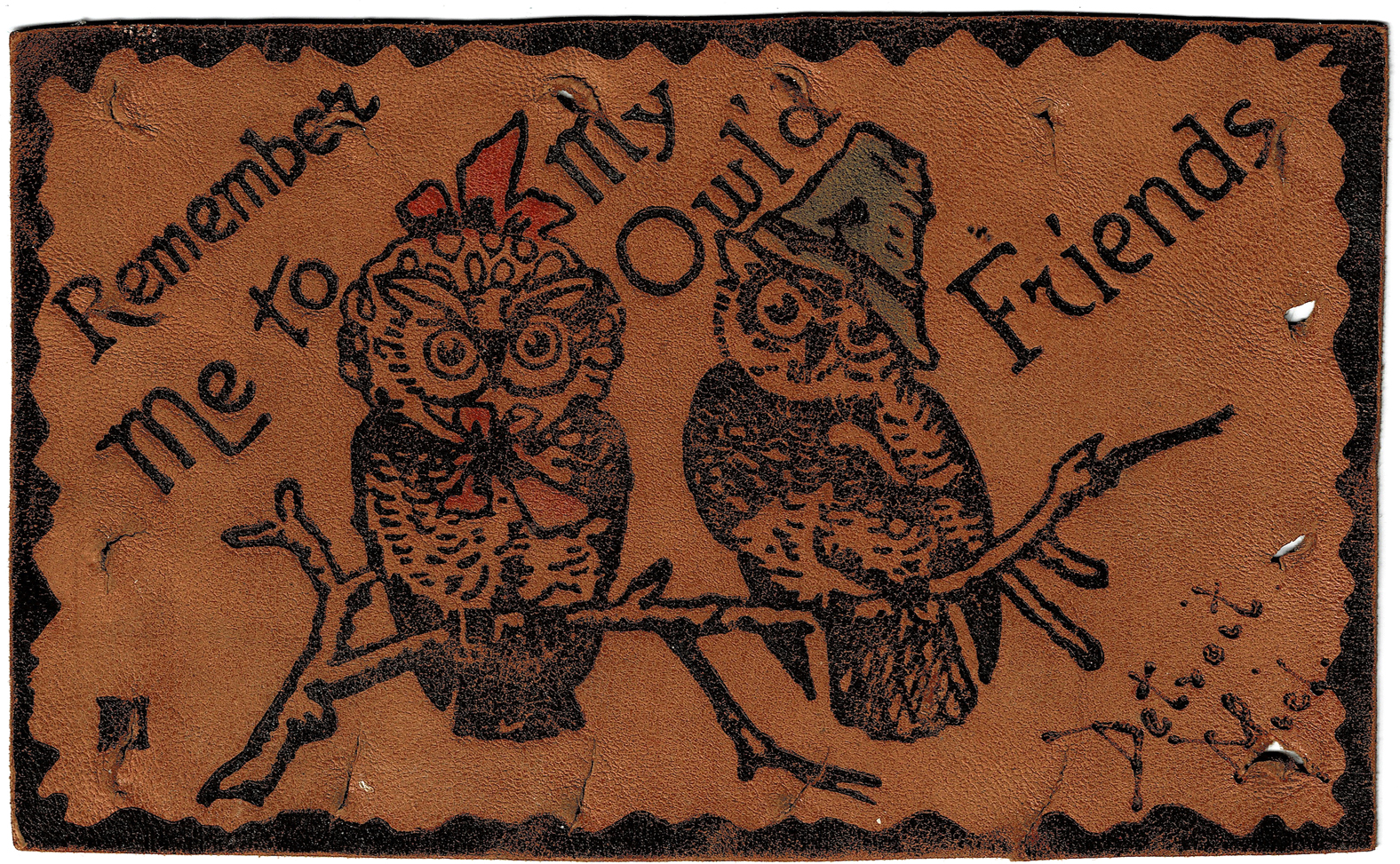
A leather postcard with two owls on it, one wearing a bonnet and the other wearing a slightly-conical hat. The message is: Remember me to my owl'd friends.
This pair of owls went to Detroit. Click to open the full image in a new tab and download it for your projects!

Subject matter varied from punny jokes like the above, to raunchy bits, to scenery. There were leather postcards for every occasion, want, or need (depending on your definition of ‘need’).

Some even had holes along the edges to allow collectors to sew their findings together into a wall-hanging or pillow! Novelty shops that sold these postcards were encouraged to display such a decoration in order to draw in more sales. Can you imagine?

The back of a leather postcard. The holes along the edges are more prominent in this shot. The words "post card" are burned into the upper part of the card, and there are lines for writing the address.
Note the holes and space to write an address—and only an address.

This fad lasted less than ten years before the United States Postal Service banned them from being mailed out—the soft, thin cards were getting stuck in mail sorting machines, making life a lot harder for the postal workers. The era of the leather postcard was over!

Temporarily.

People still sent them in the mail in envelopes instead of by themselves, and the leather postcard faded away around 1915. Many, many years later (though I’m not certain exactly when), leather postcards started showing up in Old West souvenir shops and were once more able to be mailed. Between better, newer mail sorting equipment and stiff leather being used in postcards instead of soft leather, they simply stopped causing problems.

We aren’t completely safe from the leather postcard, I guess. If we’re lucky, maybe they’re mostly contained to the American West and will leave the rest of us alone.

Until next time!

If you enjoyed this post, please consider signing up for my mailing list in the blog sidebar. You’ll get a weekly digest of The Paper Girl posts and you’ll stroke my ego, which will encourage me to do more things!
Filed Under: Blog, History, Postcards Tagged With: blog, history, leather postcards, postcards, vintage graphics, vintage images

17 Pages of an Antique Shoe Catalogue, 1912

5 September 2023

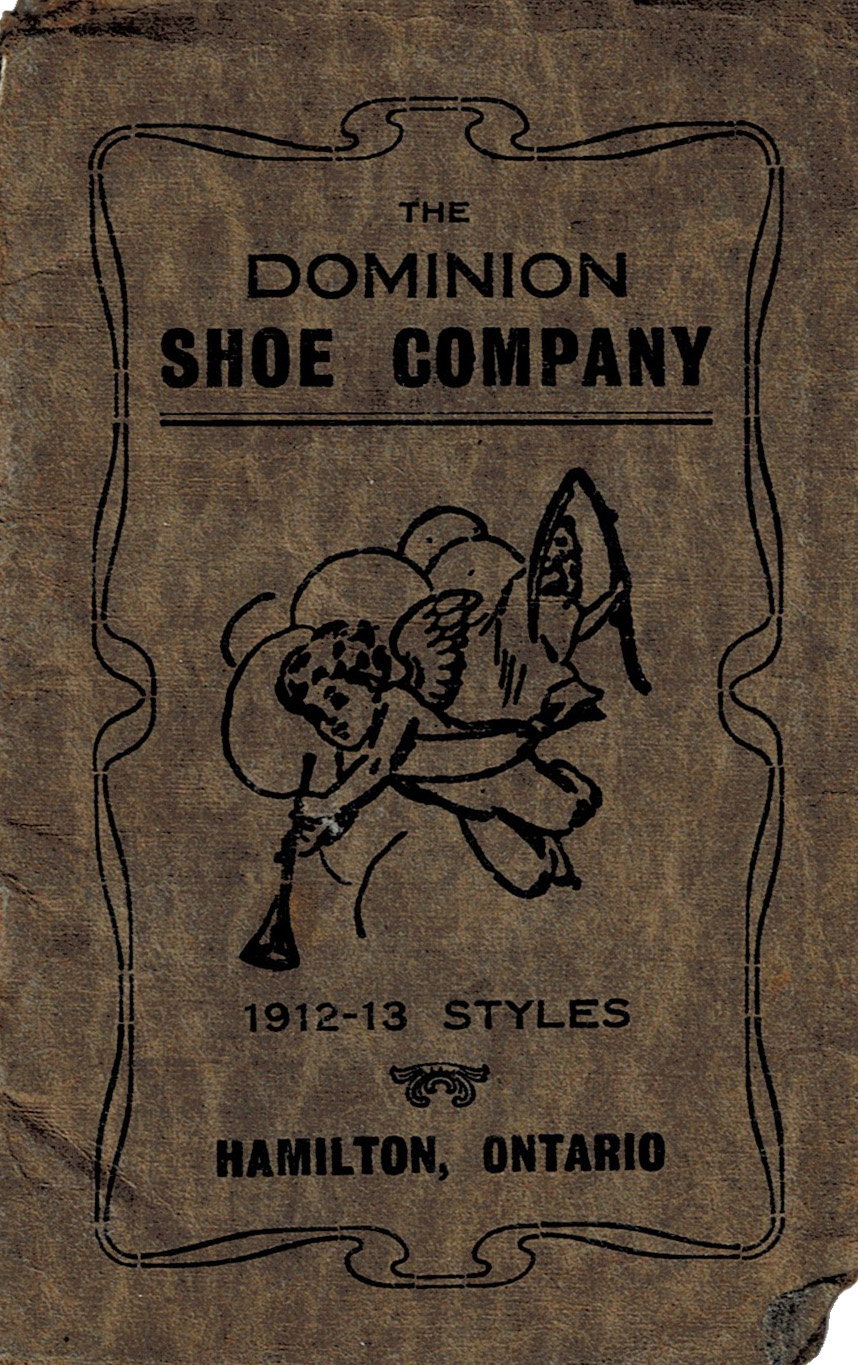
A really interesting little piece that’s in my collection is this Dominion Shoe Company Catalogue of 1912-1913 styles from Hamilton, Ontario. I haven’t been able to find any information on the company itself, but this booklet still gives a really interesting look at what was en vogue at the time.

The cover of a small booklet titled "The Dominion Shoe Company, 1912-1913 Styles, Hamilton, Ontario"

Yes, the booklet is in terrible shape on the outside: the cover is torn and creased, yet it’s a fascinating thing. What does a cherub have to do with shoes? Absolutely nothing.

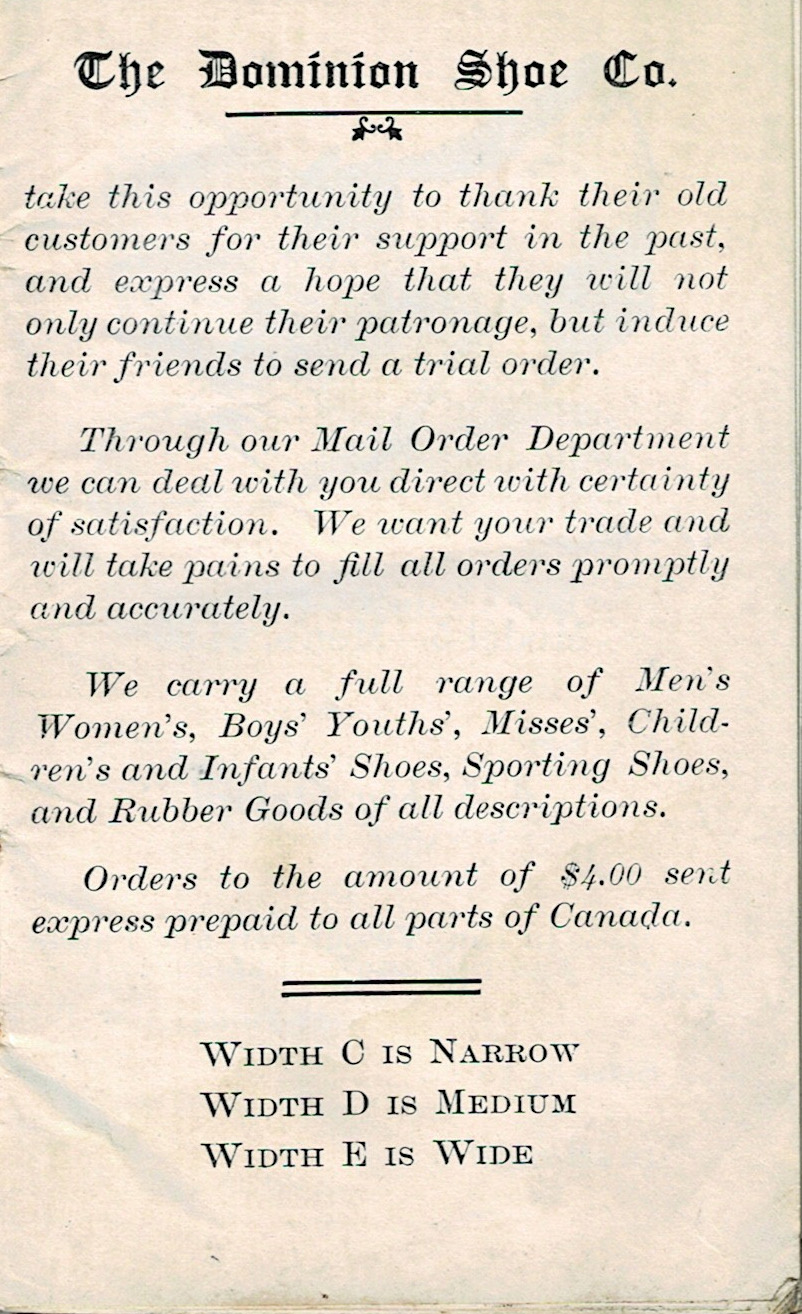
Page 1 of a small shoe catalogue.

It reads:

The Dominion Shoe Co. take this opportunity to thank their old customers for their support in the past, and express a hope that they will not only continue their patronage, but induce their friends to send a trial order.

Through our Mail Order Department we can deal with you direct with certainty of satisfaction. We want your trade and will take pains to fill all orders promptly and accurately.

We carry a full range of Men's, Women's, Boys', Youths', Misses', Children's and Infants' Shoes, Sporting Shoes, and Rubber Goods of all descriptions.

Orders to the amount of $4.00 sent express prepaid to all parts of Canada.

Width C is Narrow
Width D is Medium
Width E is Wide

According to the first page, this catalogue is but a tiny sample of what The Dominion Shoe Co. carried at the time. The addition of rubber goods is fascinating—what rubber goods did they carry? I mean, going from shoes to rubber goods of all descriptions is a bit of a jump.

Two pages from an antique shoe catalogue. On the first page is a laced shoe with a chunky heel that is described as Model 5—Men's, $4.00.  A Nobby Oxford. Made in Tan, Velour Calf and Patent Colt. Sizes 3 1/2 to 11. In all widths.

Page 2 describes a button-up shoe, Model 6—Men's $4.00. A very classy gun metal button oxford. Also made in tan, calf, and patent cold, with short vamps. Sizes 3 1/2 to 10. Widths C to E.

Each shoe is illustrated on these pages, with a title and description of materials. Even the available sizes and widths! Very classy shoes. In today’s currency they would cost approximately $126—though the prices would likely increase further than that because of the cost of materials and labour. They were made with real leather, after all.

Model 10—$4.00

A Handsome and Dressy Blucher Oxford

Made in Patent Colt and Russian Tan Calf.

Model 15

Police Bal

Goodyear Welt $4.00

McKay Sewn $3.00

A Shoe for Ease Comfort and Durability

Made in Box Calf and Dongola Kid on an extra wide last, with or without Leather lining.

These handsome shoes were also just $4.00 per pair, except for the McKay Sewn version of the Police Bal. None of those words are familiar to me.

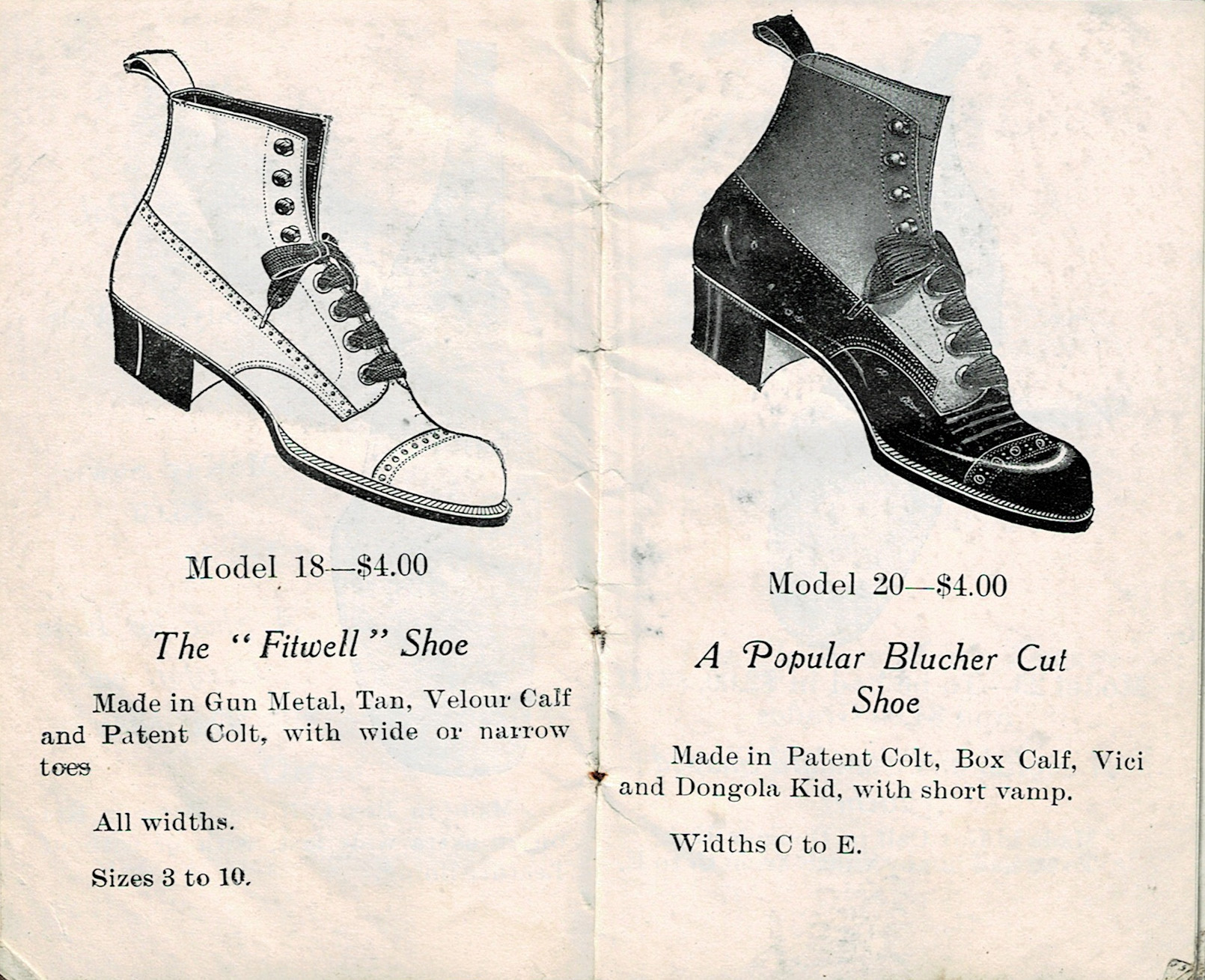
Model 18—$4.00

The "Fitwell" Shoe

Made in gun metal, tan, velour calf and patent colt, with wide or narrow toes.

All widths.

Sizes 8 to 10.

Model 20—$4.00

A popular blucher cut shoe.

Made in patent colt, box calf, Vici and Dongola Kid, with short vamp.

Widths C to E.

I like both styles of shoe listed here. Ankle support! Classy appearance! Would look extra handsome with the right suit!

Model 25—To be had in $2.00, $3.00 and $4.00 Grades

A stylish and standard shaped Blucher

Made in box calf or dongola kid. To be had in any width from C to E.

Model 30—$4.00

The business man's favorite

Storm calf leather.

To be had in black or Russian tan.

The standard-shaped Blucher listed here appears to be the everyman’s shoe, being available in multiple price grades (from a humble $2.00 up to $4.00) and in every width.

Model 35—$4.00

A treat for the feet

A button boot for gentlemen in advanced and correct style.

Made in patent colt, velour and tan calf.

Model 10—$4.00

A stylish street shoe

Blucher Bal

Made in patent colt, vici and dongola kid

What exactly is “advanced and correct style”? Let me know when you figure that out!

Model 45—$4.00

Elegance and ease

For dress or street wear.

Made in patent colt, gun metal and tan.

Widths D and E.

Model 50—$4.00

Women's colonial pump

Very popular style for the season.

Made in patent kid and gun metal.

Although Model 45 looks a bit like a clown shoe from this angle, I’m sure it was a truly elegant product in its time.

Model 55

Made in $4.00 and $3.00 grades

A nifty pump

For dress or evening wear.

Will fit snugly without gaping at sides.

Made in patent kid, Russia tan and gun metal.

High or medium heel.

Model 60

Women's

Goodyear Welt, $4.00

McKay Sewn, $3.00

An ideal and dressy Oxford.

Made in patent kid and gun metal.

All widths.

I really appreciate what looks like a bow on Model 60, in black-striped ribbon, no less!

Model 63

Made in $2.00, $3.00 and $4.00 grades.

Ankle strap pump.

Made in patent colt, tan and gun metal calf.

Medium or high heels.

To be had in all widths.

Model 65—$4.00

A captivating three-eyelet oxford.

Made in patent kid, patent colt and gun metal.

Extension sole and Cuban heel.

Although I utterly hate heels I still find the ankle strap pumps to be utterly adorable. Maybe it’s the bow. It has to be the bow.

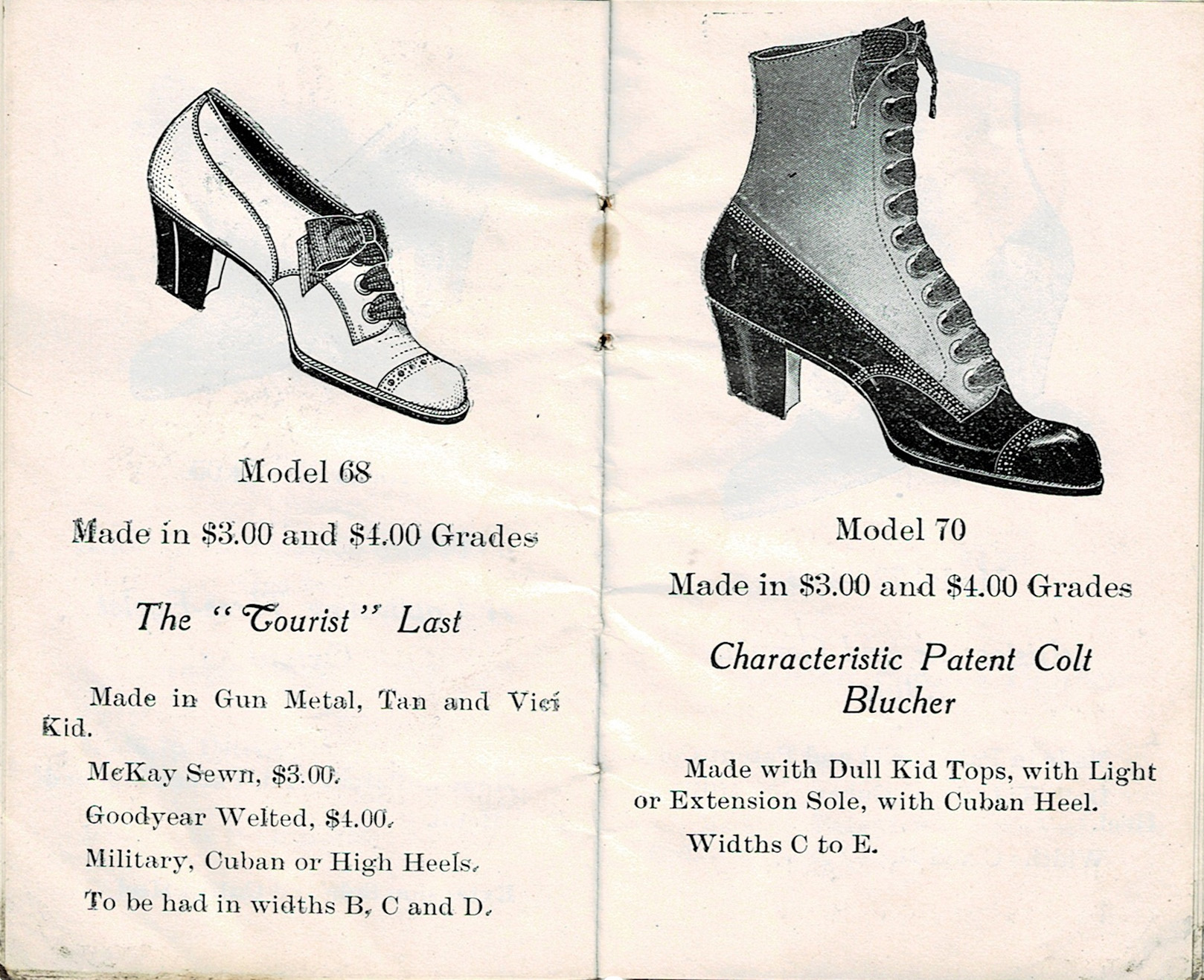
Model 68
Made in $3.00 and $4.00 grades

The "tourist" last

Made in gun metal, tan and vici kid

McKay Sewn, $3.00
Goodyear welted, $4.00
Military, Cuban, or high heels
To be had in widths B, C and D

Model 70

Made in $3.00 and $4.00 grades

Characteristic patent colt blucher

Made with dull kid tops, with light or extension sole, with Cuban heel

Widths C to E

Ah, we’re starting to get into the boots. Dark bottom half, slightly lighter top half is a very neat look.

Model 72—$4.00

Aristocratic and genuine style

Made in patent kid and patent colt.

Dull kid tops, Cuban or military heel.

Widths C and D.

Model 75—$4.00

A general favourite blucher cut.

Made in patent kid and vici, with dull kid tops, Cuban heel.

Aristocratic and Genuine Style, indeed. How about a fancy cane and hat to go with that footwear?

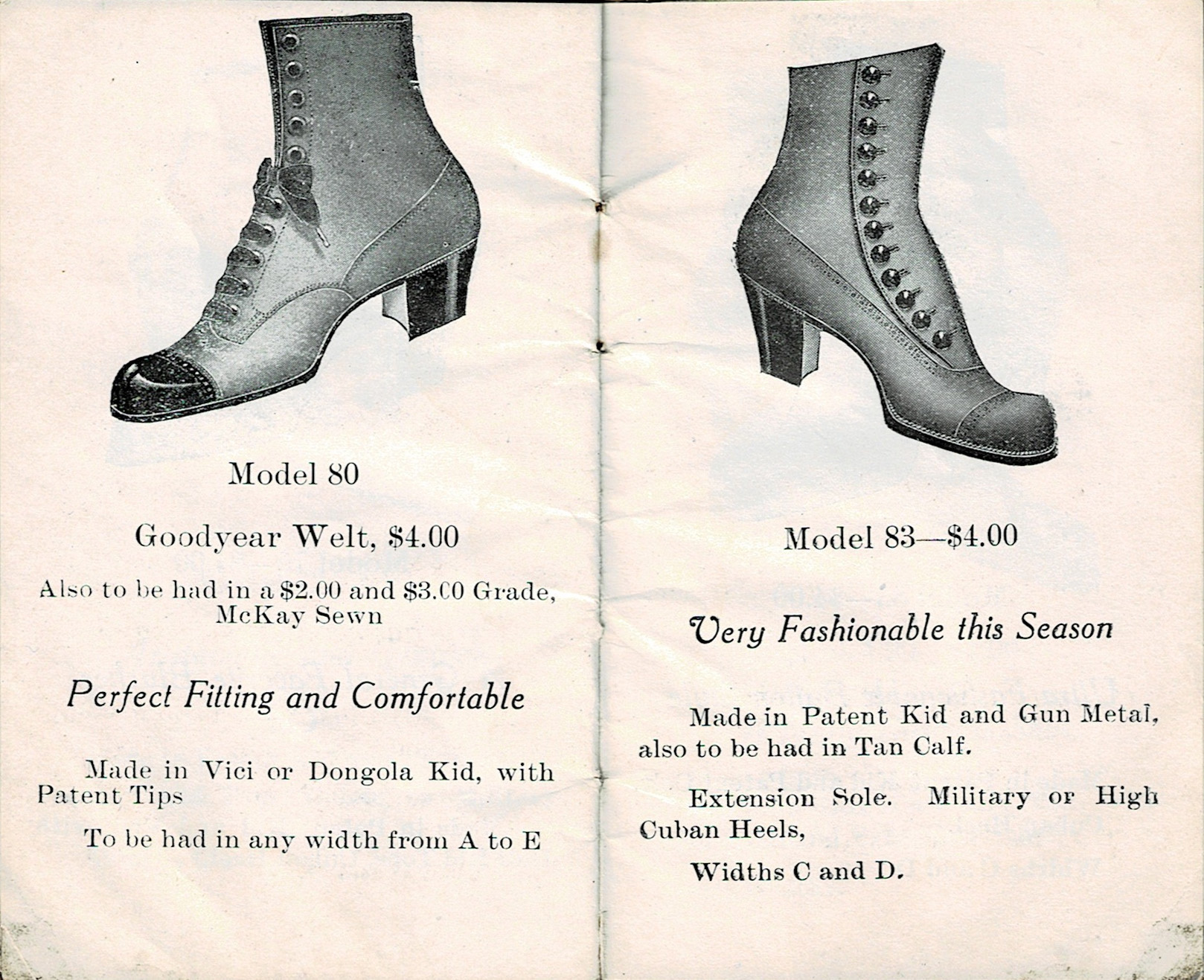
Model 80

Goodyear Welt, $4.00

Also to be had in a $2.00 and $3.00 grade, McKay Sewn.

Perfect fitting and comfortable.

Made in Vici or Dongola Kid, with patent tips.

To be had in any width from A to E.

Model 83—$4.00

Very fashionable this season.

Made in patent kid and gun metal, also to be had in tan calf.

Extension sole. Military or high Cuban heels.

Widths C and D.

A note about Vici: it’s kid leather, chrome-tanned with an oil and soap finish. This type of kidskin was developed in the 1880s and featured in the likes of Vanity Fair, very fancy stuff. Kidskin itself is a very soft and thin leather that was mostly used for gloves. Sometimes lambskin or calfskin were used instead as they were similarly soft and thin.

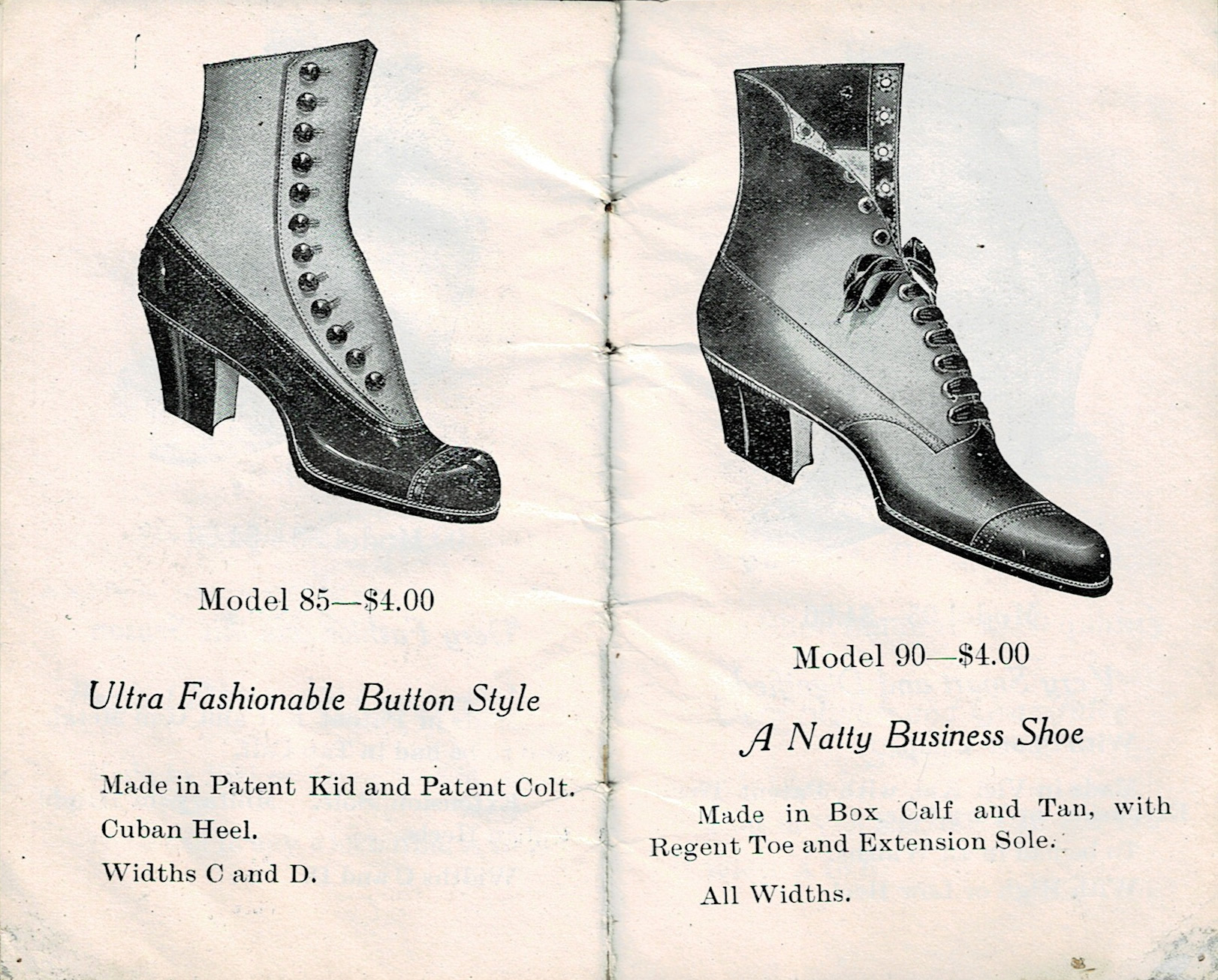
Model 85—$4.00

Ultra fashionable button style

Made in patent kid and patent colt.

Cuban heel.

Widths C and D.

Model 90—$4.00

A natty business shoe

Made in box calf and tan, with regent toe and extension sole.

All widths.

The word ‘natty’ means neat, as in fashionable. This term was coined in the 18th century and would still have been in common use in the early 20th century. It’s definitely not slang that I hear very often, though a lot of that is from me being in northeastern Ontario and not, say, London, England.

Model 95—$4.00

Very smart and dignified

With short vamp.

Made in vici kid, with patent tips. Extension, or turn sole.

To be had in all widths.

With high or low heel.

Madel 100—Goodyear $4.00
Same shoe made in $3.00 quality

Very stylish and gracefully shaped

Made in vici kid, box calf and tan.

Width A to E.

I love how the descriptions repeat themselves, just with different wording, as if the writer was flipping through a thesaurus the entire time.

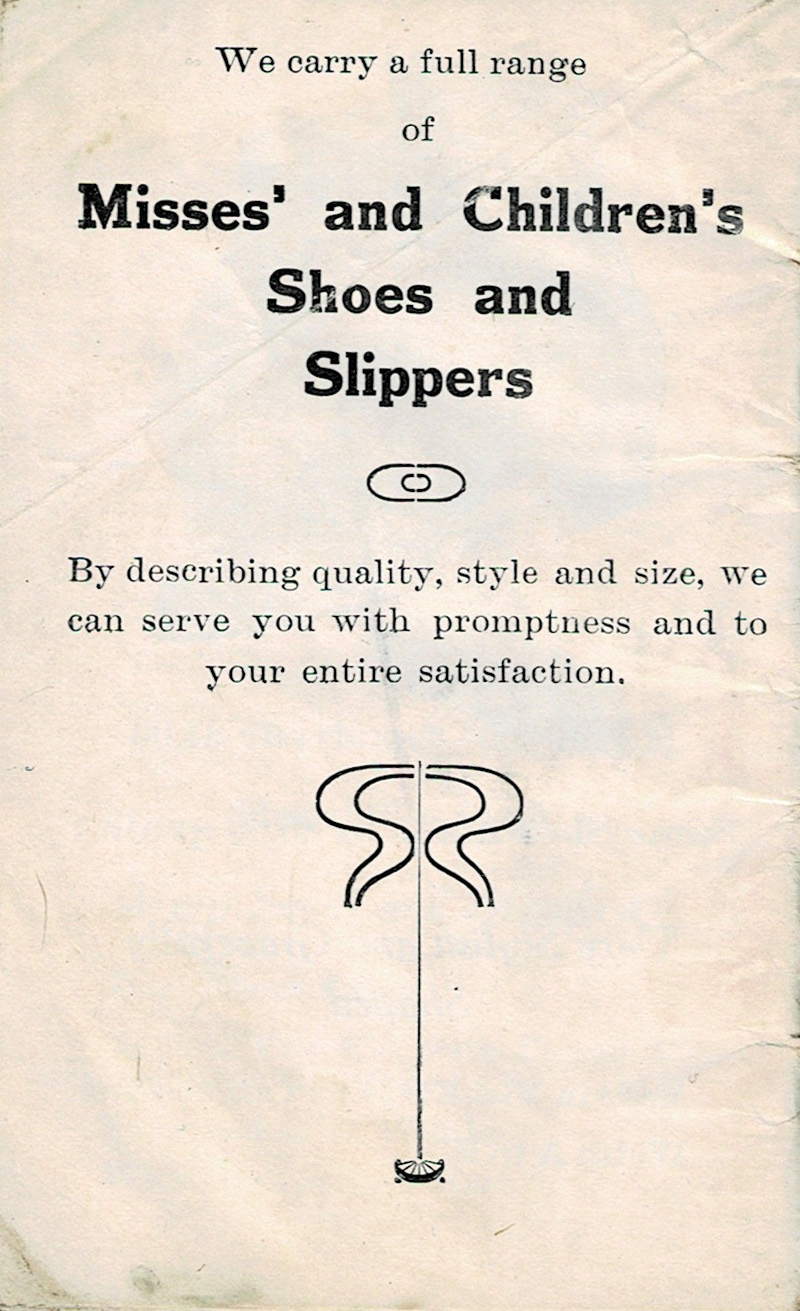
We carry a full range of Misses' and Children's shoes and slippers.

By describing quality, style and size, we can serve you with promptness and to your entire satisfaction.

This is the very last page. A couple of interesting decorative elements here, as well as the hope that the reader will seek this company out for other products.

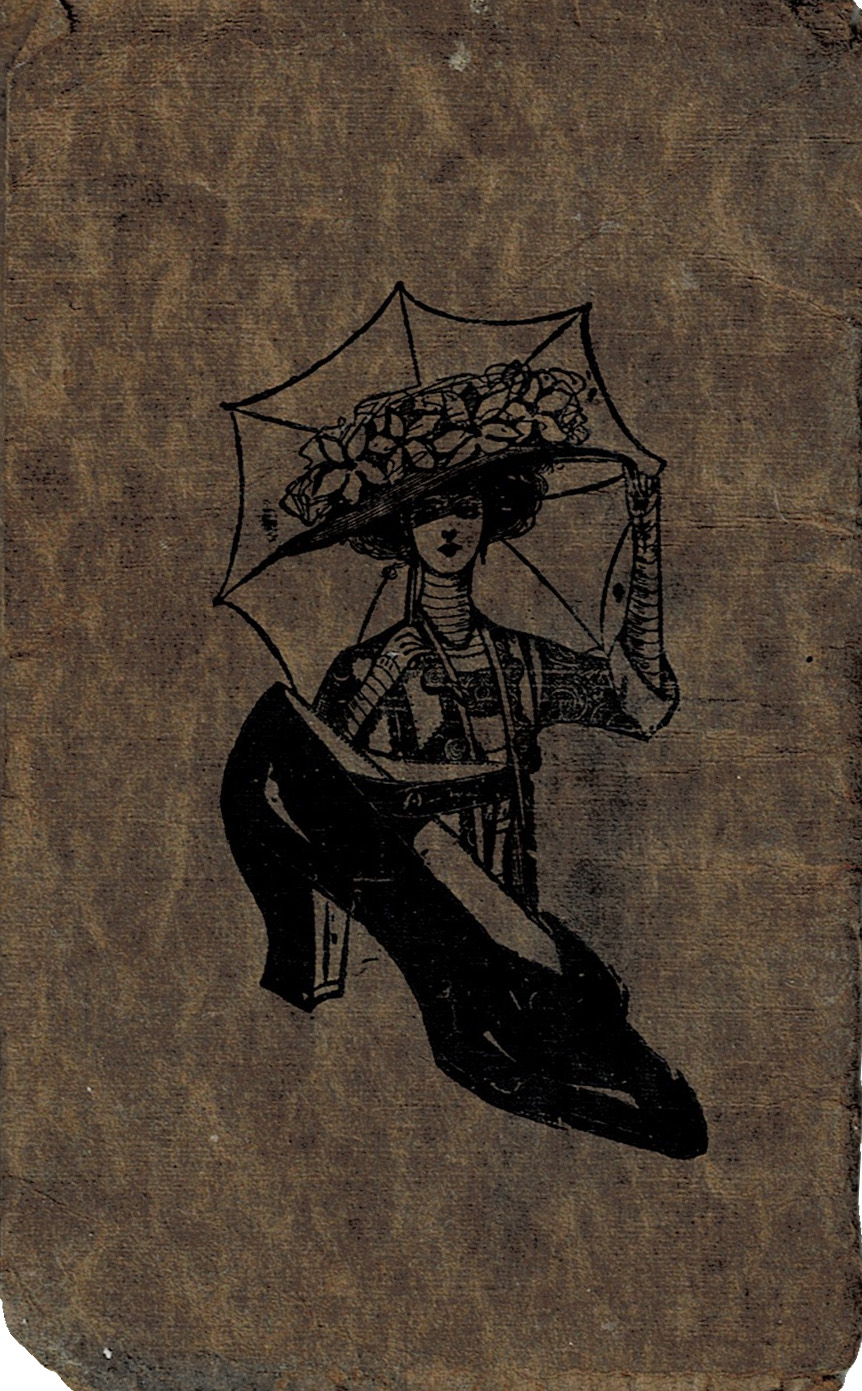
An illustration of a woman with a parasol, wearing a flowered wide-brim hat. She stands behind a big shoe.

The back cover. I love this graphic. The lady with her parasol, looking rather stylish, and the shoe just… existing there, as they do.

What did you think of The Dominion Shoe Company’s selection? Did you have a favourite type of shoe?

I hope you’ll join me again soon for more vintage graphics, and remember to subscribe to my mailing list!

Filed Under: Blog, Ephemera, Vintage Graphics Tagged With: books, cherub, people, shoes, vintage graphics, vintage images, women

Cabinet Card Folder & Cover

20 August 2023

I’m rather excited about the piece I have for you this week.

You’ll have to excuse my tardiness—I had a very sudden bug hit me on Thursday evening and I’ve been out of commission until today. It’s terrible, but it’s also the only time I’ve been sick in several years. I’ll take that over how sick I used to get every year when I was working with the public all the time. Getting that sick now would be far more concerning than it was back in ye olde days as I have no idea how well I’d bounce back!

At any rate.

Cabinet cards replaced the much smaller carte de visite, and in the process, they also managed to toss traditional photo albums by the wayside for a good thirty years or so until manufacturers were able to adapt.

Photography studios got very creative with how they presented these pictures to their clients, especially since the final product would be displayed in cabinets (as per the name) or elsewhere in the home, where they could be seen by anyone instead of tucked away in photo albums.

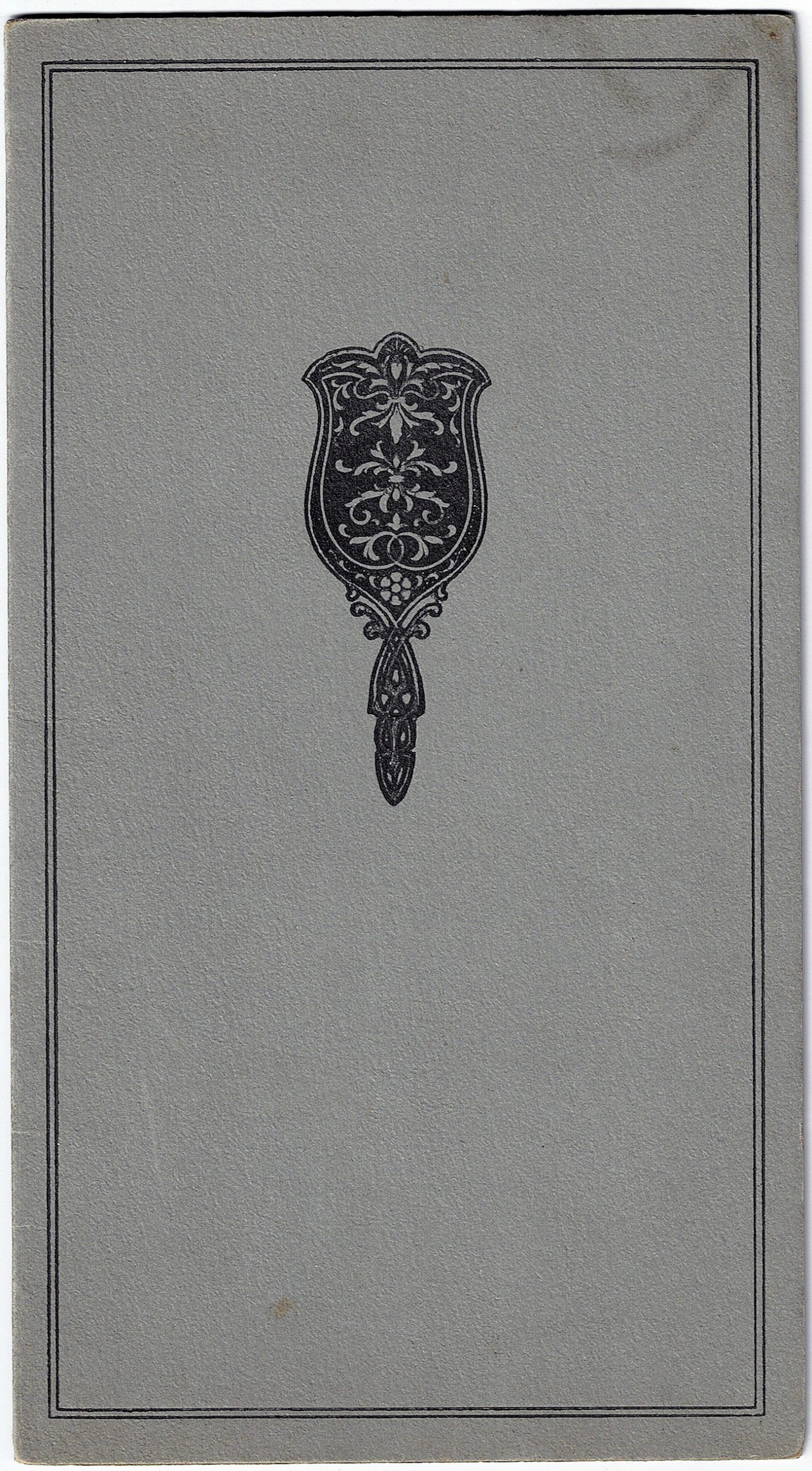
This folder came with one of the cabinet cards in my collection. It’s heavy cardstock with a slightly-embossed design on the front, and would open up to reveal the cabinet card tucked inside. This is just one example of many that are out there, but this one is mine.

Photographers would decorate their work with their name in fancy script on the picture’s frame and/or holder. You would also find the studio’s full logo in all its stylized glory plastered on the back of some cabinet cards, depending on the decade, or decorating the folder somewhere. Embossing was especially beloved.

So much love and skill went into the creation of each cabinet card and its associated media. Each aspect is a piece of art on its own that’s worthy of study and interest. That’s what I love the most. It also makes figuring out eras a lot easier when there are certain features, like use of heavy cardstock instead of light cardstock, that were all the rage in each decade.

Here is the inside cover of a cabinet card holder. It had scalloped edges—popular in the 1890s—with an embossed design on one panel and the photographer’s information tucked into a corner (C.A. Lee of Listowel, Canada, took the photo that was contained in this folder). A previous owner wrote the information pertaining to the cabinet card: Mary Isobel Jickling, Dec. 23, 1915. She passed away in 2013.

I recommend using the above image as a background for a larger piece. There’s so much texture here! It’s worn with age, but not to the point where it can’t be given new life in an artistic endeavour, and it’s on a canvas-style cardstock. Very cool.

That’s all for today. I am working on a fresh batch of vintage graphics for you all to browse, so stay tuned and see you soon.

Filed Under: Blog, Ephemera, Vintage Graphics Tagged With: c.a. lee, cabinet cards, ephemera, listowel ontario, vintage graphics, vintage images

  • « Previous Page
  • 1
  • …
  • 8
  • 9
  • 10
  • 11
  • 12
  • …
  • 25
  • Next Page »

Hello!

I'm Mel, a vintage reseller and ephemera collector. I share pieces from my collection, insights into the antique business, tips, and graphics. Join me for inspiration for your vintage art and antiquing adventures!

  • Facebook

Looking for something?

Be the First to Know

Get a hunka hunka burnin’ love for your inbox and sign up for my newsletter, mama.
Sign me up

Affiliate Disclosure

I sometimes include affiliate links in my posts and emails. Every purchase made through those links supports my work.

Canadian Badge

Mel Recommends

bACK TO TOP
  • Facebook

Copyright © 2026 · Designed by Designer Blogs